




Maximizing Your Personal and Pass-Through Deductions

For high-earning business owners, real estate investors, and high-net-worth households, routine annual giving frequently produces zero incremental tax benefit, because the standard deduction is now large enough that modest annual gifts don’t reliably push a household past the itemizing threshold. Bunching solves this without asking anyone to give a dollar more over time — it only changes when the dollars are given.
Who This Strategy Is For
- Households whose baseline itemized deductions (state/local taxes + mortgage interest) sit below the standard deduction, so routine annual giving isn’t clearly getting them any tax credit for itemizing.
- Business owners or investors expecting a one-time income spike — a business sale, a large K-1 distribution, or vested equity — who want a large, timely deduction to offset it.
- Donors holding appreciated stock, real estate, or business interests they’re willing to contribute rather than sell outright.
- Anyone comfortable using a donor-advised fund (DAF) as a holding vehicle, so the tax deduction and the actual grants to nonprofits don’t have to happen in the same calendar year.
How Bunching Works
Instead of donating $8,000 every year for three years, a couple concentrates their giving — contributing $24,000 in Year 1 and $0 in Years 2 and 3.
Here’s a 2026-accurate illustration. Assume a married couple has $24,000 in baseline itemized deductions (state and local taxes plus mortgage interest, comfortably under the current $40,400 SALT cap) and the 2026 standard deduction of $32,200 for married filing jointly.
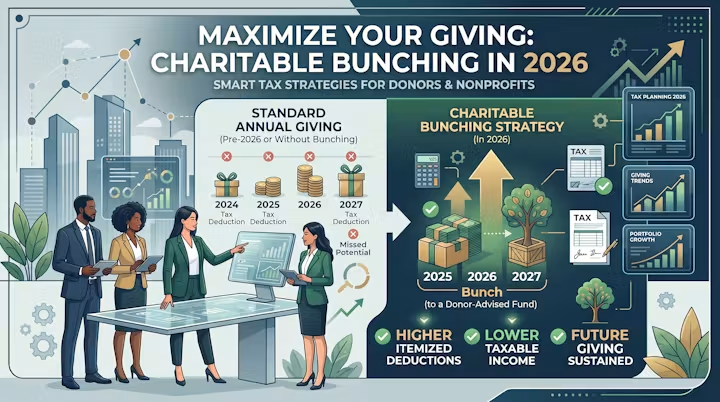
Comparative 3-Year Deduction Schedule (Tax Year 2026 Figures)
| Tax Metric | Annual Giving Strategy ($8k/yr) | Structured Bunching Strategy ($24k in Year 1) |
|---|---|---|
| Year 1 Deductions | $24k baseline + $8k gift = $32,000 → below the $32,200 standard deduction, so Standard ($32,200) applies | $24k baseline + $24k gift = $48,000 (Itemize) |
| Year 2 Deductions | $24k baseline + $8k gift = $32,000 → Standard ($32,200) | $0 gift → Standard ($32,200) |
| Year 3 Deductions | $24k baseline + $8k gift = $32,000 → Standard ($32,200) | $0 gift → Standard ($32,200) |
| 3-Year Total Deductions | $96,600 | $112,400 |
This example ignores the new 0.5% AGI floor on charitable deductions, covered next, which would modestly trim the deductible amount in an itemizing year.
By bunching, this couple captures $15,800 in additional deductions over the same three years, from the exact same $24,000 given to charity — because under the annual strategy their giving never actually clears the standard deduction threshold, so it produces no incremental tax benefit at all. A higher standard deduction under OBBBA makes this dynamic more common for routine annual givers, not less — which is exactly why bunching has become more relevant in 2026, not obsolete.
The 2026 Regulatory Environment
The 0.5% AGI Floor
Beginning with tax year 2026, OBBBA imposes a new statutory floor on itemized charitable deductions equal to 0.5% of Adjusted Gross Income (AGI). Only the portion of your giving that clears this floor counts toward your itemized deduction. This is new — no such floor existed pre-2026.
What the 0.5% AGI floor means for high earners:
- $200,000 AGI: the first $1,000 of annual giving is non-deductible.
- $500,000 AGI: the first $2,500 of annual giving is non-deductible.
- $1,000,000 AGI: the first $5,000 of annual giving is non-deductible.
Because the floor is applied once per tax year rather than once per dollar given, bunching shrinks its total bite. If an entrepreneur with $500,000 AGI gives $5,000 a year for three years ($15,000 total), the floor absorbs $2,500 every year — $7,500 total — leaving only $7,500 deductible. Bunch that same $15,000 into one year, and the floor absorbs $2,500 only once, leaving $12,500 fully deductible. Same gift, $5,000 more in usable deduction.
The 37% Bracket Deduction Cap
A second 2026 change matters for this exact audience: OBBBA reinstates a limitation on itemized deductions for taxpayers in the top 37% federal bracket, effectively capping the tax value of each deducted dollar at 35 cents instead of 37 cents. This doesn’t eliminate the case for bunching — a large deduction is still worth more than a small one — but it does modestly reduce the dollar value of every bunched deduction for households in the top bracket, and it’s worth modeling explicitly rather than assuming a flat 37% benefit.
New: The Above-the-Line Deduction for Non-Itemizers
OBBBA also created a benefit that changes what happens in your “off” years. Starting in 2026, taxpayers who claim the standard deduction can still deduct cash gifts to qualified public charities above the line — up to $1,000 for single filers or $2,000 for married filing jointly. Two things to know:
- This deduction is cash-only and excludes gifts to donor-advised funds, private foundations, and supporting organizations — so it does not stack with the DAF strategy below.
- It means an “off year” in a bunching plan doesn’t have to mean zero charitable deduction. A couple can still direct up to $2,000 a year in cash gifts directly to an operating charity and capture a deduction even while claiming the standard deduction.
Decoupling Deductions from Giving: Donor-Advised Funds (DAFs)
A common concern with bunching is maintaining steady support for nonprofits that rely on predictable annual operating grants. A Donor-Advised Fund (DAF) solves this by decoupling the tax deduction from the actual grantmaking:
- In your high-income bunching year, you contribute several years’ worth of planned giving to the DAF and take the full deduction immediately.
- The capital sits invested, tax-free, inside the DAF.
- You issue grants out to Charity A, Charity B, and Charity C on whatever multi-year schedule you choose — Year 1, Year 2, Year 3, or beyond.
When you contribute cash or long-term appreciated securities to a DAF, you claim a fair-market-value deduction in the contribution year, the capital grows tax-free while awaiting distribution, and you control the grant timeline independently of the tax deduction.
Tax tip: Donating long-term appreciated stock or real estate directly to a DAF avoids capital gains tax on the appreciation entirely while still capturing a fair-market-value deduction — a genuine double benefit. Two caveats worth flagging to a client: cash gifts to public charities (including DAFs) are limited to 60% of AGI, and gifts of appreciated property are limited to 30% of AGI, with a five-year carryforward for any excess — a meaningful consideration when bunching a very large, concentrated gift.
Note: DAF contributions do not qualify for the new $1,000/$2,000 non-itemizer above-the-line deduction described above — that benefit is reserved for gifts made directly to operating public charities.
Strategic Integration for Pass-Through Entity Owners
For owners of S corporations, partnerships, and LLCs, charitable contributions generally do not reduce entity-level net income (unless the payment genuinely qualifies as a business promotion expense under IRC §162, rather than a charitable contribution). Instead, the entity’s charitable gifts flow through to the owner’s individual return via Schedule K-1 and are claimed as itemized deductions on Schedule A — but the box differs by entity type:
- S corporations (Form 1120-S): reported in Box 12, codes A–G.
- Partnerships and multi-member LLCs taxed as partnerships (Form 1065): reported in Box 13, codes A–G.
To maximize the power of charitable bunching, align your personal giving strategy with corporate-level planning:
Manage AMT and income spikes. Charitable deductions, unlike SALT, are allowed in full under the Alternative Minimum Tax, so bunching charitable gifts — unlike bunching SALT payments — doesn’t create AMT exposure. That makes charitable bunching a comparatively “clean” lever for absorbing a one-time income spike, such as an asset sale or large year-end distribution.
Coordinate with Section 179 and bonus depreciation. Timing large equipment purchases or accelerated depreciation at the business level in the same year you bunch charitable giving helps smooth an income spike using two levers at once, rather than treating them as unrelated decisions.
Combine with PTET workarounds. Pass-Through Entity Tax (PTET) elections let the entity pay state tax directly and deduct it in full at the entity level, bypassing the federal SALT cap that applies to the owner’s personal return — a complementary, not competing, strategy to personal itemizing.
Don’t Overlook Qualified Charitable Distributions (QCDs)
For owners age 70½ or older, a QCD is often the single most tax-efficient giving vehicle available — and it works alongside, not instead of, bunching. A QCD sends money directly from a traditional IRA to a qualifying public charity (DAFs are not eligible), and it’s excluded from AGI entirely rather than deducted — up to $111,000 per person in 2026, or $222,000 for a couple with separate IRAs. Because a QCD lowers AGI directly instead of competing with the standard deduction, it also sidesteps the new 0.5% AGI floor and can help satisfy required minimum distributions at the same time.
Executing a Multi-Year Tax Plan
Effective tax planning is proactive, not reactive. Rather than treating tax prep as an annual compliance exercise, high-net-worth business owners should model income, capital gains, and deduction strategies across a rolling 3- to 5-year window — one that reflects current-year figures for the standard deduction, SALT cap, and AGI floor, since all three are indexed and will shift again in future years.
Working with a qualified CPA ensures your business structure, personal tax position, and philanthropic goals stay aligned — and that the numbers you’re planning around match the law as actually enacted, not an earlier draft of it. That’s why having a conversation with TYS should be on your radar. Contact us today!
Frequently Asked Questions
What is charitable bunching?
Charitable bunching is the practice of consolidating multiple years of planned charitable donations into a single tax year so total itemized deductions clearly exceed the standard deduction, then claiming the standard deduction in the intervening years.
What is the 0.5% AGI floor on charitable deductions?
Starting in tax year 2026, itemizers can only deduct the portion of their charitable giving that exceeds 0.5% of their Adjusted Gross Income. For example, at $500,000 AGI, the first $2,500 given in a year is not deductible.
Can I use a donor-advised fund (DAF) to bunch donations?
Yes. Contributing several years of planned giving to a DAF in one year lets you claim the full deduction immediately while distributing grants to charities on your own multi-year schedule. DAF contributions, however, do not qualify for the new $1,000/$2,000 non-itemizer above-the-line deduction.
Do I still get a charitable deduction in years I take the standard deduction?
Starting in 2026, yes, up to a point: taxpayers claiming the standard deduction can deduct up to $1,000 (single) or $2,000 (married filing jointly) of cash gifts to qualifying public charities above the line — though not gifts to DAFs.
Does bunching charitable gifts trigger the Alternative Minimum Tax (AMT)?
No. Charitable deductions are allowed in full under the AMT, unlike the SALT deduction, so bunching charitable giving doesn’t create the AMT exposure that bunching state and local tax payments can.
Is charitable bunching still worthwhile if I’m in the 37% tax bracket?
Generally yes, though the value is somewhat reduced: OBBBA caps the tax value of itemized deductions for top-bracket taxpayers at 35 cents per dollar rather than 37 cents. A CPA can model the after-cap benefit for your specific numbers.