




The Child Tax Credit Guide provides high-income taxpayers and business owners with actionable insights to maximize family tax savings while optimizing overall liability. For the current tax year, the Child Tax Credit (CTC) offers up to $2,200 per qualifying child under age 17, with phase-out thresholds beginning at $400,000 for joint filers and $200,000 for single filers. Proactive financial strategies—such as income timing, pass-through entity optimization, and employing family members—allow business owners to preserve credit eligibility and capture valuable business tax deductions.
Understanding Child Tax Credit Thresholds and Phase-Out Rules
Navigating family tax credits requires a clear view of IRS eligibility rules and income limits. The federal Child Tax Credit provides a dollar-for-dollar reduction of your tax bill. However, modified adjusted gross income (MAGI) phase-outs can reduce or eliminate this credit for higher-earning households.
If your income exceeds the statutory limits, the credit phases out at a rate of $50 for every $1,000 of MAGI above the threshold. Understanding these boundaries helps families plan cash flow and year-end distributions accurately.
| Tax Provision | Statutory Limit / Threshold | Key Taxpayer Impact |
| Maximum Credit per Child | Up to $2,200 per child under 17 | Direct dollar-for-dollar tax liability reduction. |
| Refundable Portion (ACTC) | Up to $1,700 per qualifying child | Refundable portion for low tax liability scenarios. |
| MAGI Phase-Out (Joint) | $400,000 for Married Filing Jointly | Credit reduces above this income limit. |
| MAGI Phase-Out (Single) | $200,000 for Single / Head of Household | Credit reduces above this income limit. |
| Credit for Other Dependents | $500 per dependent | Applies to dependents aged 17–23 or full-time students. |
Maintaining complete alignment between individual filings and business distributions is essential. Working alongside knowledgeable tax accountants ensures you leverage every available strategy before hitting hard income phase-outs.
Business Tax Deductions and Income Management Strategies
For closely held business owners, tax planning extends beyond simple return filing. Strategic business decisions directly impact your personal MAGI and Child Tax Credit eligibility.
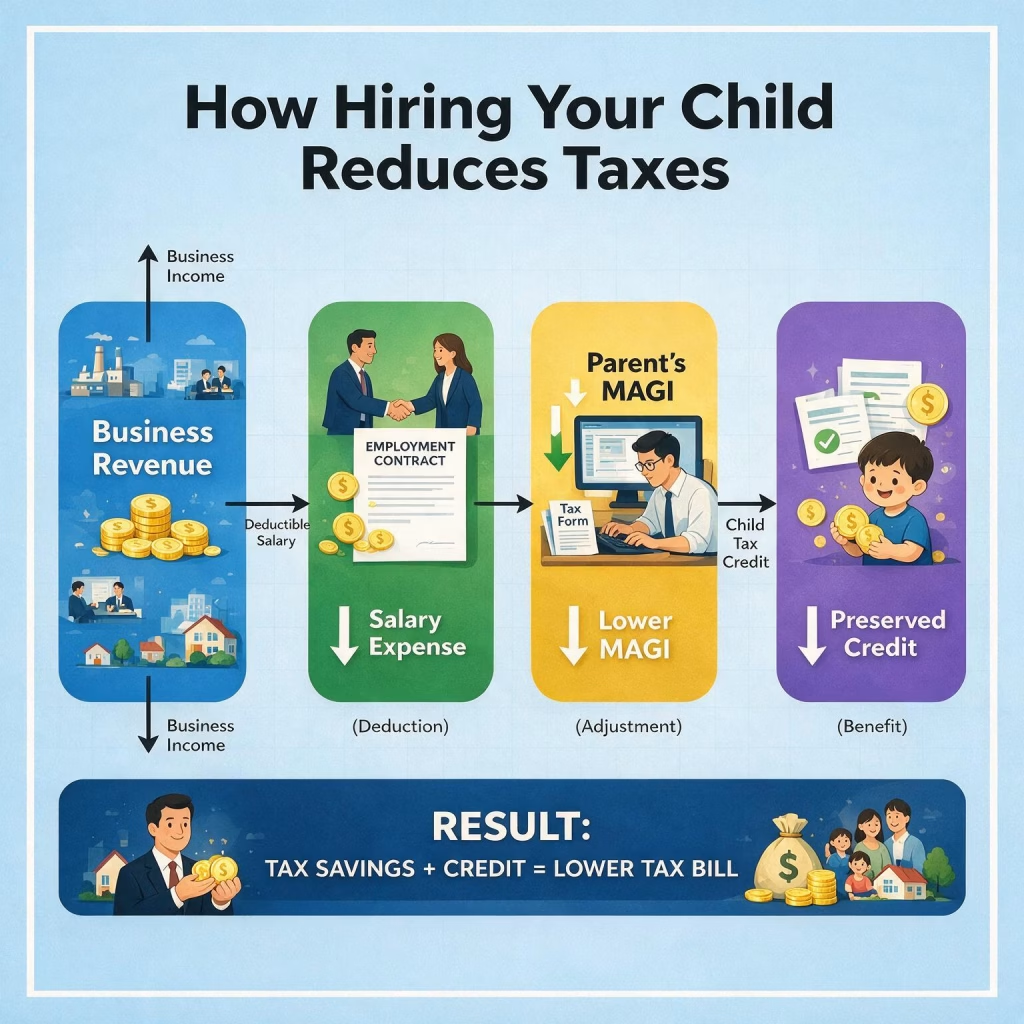
1. Employing Your Children in the Family Business
Business owners can legitimately hire their children to perform necessary work. Wages paid to children under 18 from a sole proprietorship or single-member LLC are exempt from FICA taxes. Furthermore, the child can utilize the standard deduction to earn tax-free income while creating a valid business expense deduction for the parent.
2. Accelerating Capital Investments via Section 179
Using the Section 179 deduction allows businesses to write off the full purchase price of qualifying equipment and software in the year placed in service. This deduction lowers pass-through entity taxation, directly reducing the owner’s net Schedule K-1 income and keeping MAGI below phase-out triggers.
3. Structuring Pass-Through Entity Taxation
Owners of S corporations and partnerships can adjust the mix of W-2 salary and distributions. Managing reasonable compensation alongside pass-through entity taxation helps keep personal adjusted gross income within favorable tax credit brackets.
Year-End Tax Prep and IRS Compliance
Integrating family tax credits into your broader financial plan requires accurate tax prep and ongoing compliance tracking. The IRS enforces strict substantiation requirements for dependents, including valid Social Security Numbers issued before return due dates.
Key compliance considerations for high-income taxpayers include:
- Dependent Age Verification: The child must be under age 17 on December 31 of the tax year. Children turning 17 during the year transition to the $500 Credit for Other Dependents.
- Residency and Support Tests: The qualifying child must reside with the taxpayer for more than half the year and cannot provide more than half of their own financial support.
- Documenting Business Wages: If employing children, keep clear payroll records, detailed timesheets, and written job descriptions to withstand IRS scrutiny.
- Coordinating Educational Credits: Balance the CTC with the American Opportunity Tax Credit (AOTC) or college savings plan distributions as children grow older.
Proactive advisory services prevent unexpected tax bills and help business owners maintain multi-year tax efficiency.
Choosing the Right Advisory Partner for Your Business
Selecting a long-term partner for your tax and accounting needs is critical for preserving wealth. When searching for a tax accountant near me, look for firms that prioritize strategic guidance over basic data entry.
Essential qualities in an accounting firm include:
- Proactive Tax Planning Strategies: Year-round structuring rather than once-a-year return preparation.
- Deep Business Expertise: Mastery of entity selection, Section 179 planning, and profit distribution optimization.
- Comprehensive CPA Services for Small Business: Integrated bookkeeping, advisory, and tax defense services.
With over 60 years of experience, TYS Advisors delivers tailored accounting and strategic tax planning solutions. Our team helps entrepreneurs and high-net-worth families navigate evolving tax laws while capturing every eligible credit.
Frequently Asked Questions
What is tax prep for small businesses with qualifying dependents?
Small business tax prep combines individual dependent credit calculations with entity-level accounting. It ensures pass-through income, business tax deductions, and family tax credits are fully optimized to minimize overall tax liability.
How do I choose a tax accountant near me for complex tax planning?
Focus on selecting knowledgeable tax accountants who specialize in small-to-medium businesses and high-net-worth tax planning. Seek a partner who offers proactive advisory services, entity structure optimization, and audit defense support.
What happens to the Child Tax Credit if my child turns 17 during the tax year?
If your child reaches age 17 at any point during the tax year, they no longer qualify for the Child Tax Credit. However, you may still claim the $500 Credit for Other Dependents if they meet the remaining dependency criteria.
How do business tax deductions help maintain Child Tax Credit eligibility?
By maximizing legitimate deductions—such as equipment depreciation under Section 179 or hiring family members—you reduce your business net income. Lowering your overall MAGI helps keep your earnings below the $200,000 or $400,000 phase-out thresholds.
With over 60 years of tax accounting experience, TYS Advisors provides proactive tax planning, advisory, and compliance services to help small-to-medium business owners and high-net-worth individuals minimize tax liabilities, navigate complex legislative changes, and achieve long-term financial growth.
Contact TYS Advisors today at our Rochester, NY or Walnut Creek, CA offices to schedule your strategic tax consultation.