




Profitable on Paper, Short on Cash? Your Forecast Needs to Move Faster.
Short answer: Rising interest rates, stubborn inflation, and slow-paying corporate customers have squeezed small business cash flow from every direction. Your customers take longer to pay you, while your suppliers, lenders, and payroll still expect payment on time. A quarterly forecast can’t catch a cash crunch that builds in weeks. A rolling 13-week cash flow forecast, reviewed weekly, gives you the early warning you need to protect working capital and keep growing.
Key Takeaways
- The Federal Reserve raised rates in September 2026 for the first time since 2023, and officials expect more increases.
- The prime rate now sits at 7.00%, which raises the cost of lines of credit and variable-rate loans.
- Late payments affect an average of 22% of U.S. business-to-business receivables.
- Slow receivables plus fast payables create a cash gap you must finance, at higher rates than a few years ago.
- A rolling 13-week cash flow forecast turns cash management from guesswork into a weekly decision tool.
Why Your Cash Feels Tighter Than Your Profits
You can post a strong year on your income statement and still struggle to make payroll. Profit measures what you earned. Cash measures what you actually collected. When those two numbers drift apart, growing businesses feel the squeeze first.
Right now, three forces are pulling them apart.

Force 1: Borrowing Costs Are Rising Again
On September 16, 2026, the Federal Reserve raised its benchmark rate by a quarter point to a range of 3.75% to 4%, its first increase since July 2023 (CNBC). Sixteen of 18 Fed officials expect another increase before the end of 2026 (CNBC).
Banks responded immediately. Wells Fargo raised its prime rate to 7.00% effective September 17, 2026 (Business Wire via Yahoo Finance). When the Fed raises rates, business loan rates, including SBA 7(a) rates, tend to rise with them (NerdWallet).
If you rely on a line of credit to cover the gap between paying bills and collecting invoices, that gap now costs you more every month.
Force 2: Inflation Keeps Squeezing Margins
The Fed projects headline inflation of 3.7% for 2026 and doesn’t expect to return to its 2% target until 2029 (CNBC). Small business owners feel it. In Q2 2026, 34% of small businesses named inflation their top challenge, with cash flow close behind at 30% (OnDeck). In Q1 2026, cash flow topped the list for the first time (OnDeck).
Owners are already making hard trade-offs. In Q2 2026, 57% of small businesses used a business line of credit to manage cash flow, and 49% delayed paying themselves or family members (OnDeck).
Force 3: Customers Pay Slowly, Bills Arrive Fast
This is where the squeeze gets personal.
About seven in ten U.S. companies still face late payments, and late payments affect an average of 22% of B2B receivables (Atradius). Fifty-five percent of U.S. suppliers report that business customers delay invoice payments, most often because those customers lack the cash to pay on time (Atradius). Even with typical settlement patterns, suppliers usually wait about two months from invoice to cash (Atradius).
Large corporate clients make it worse. They often dictate long payment terms, route invoices through slow approval chains, and pay on their schedule, not yours.
Meanwhile, your obligations don’t wait. Payroll runs every two weeks. Rent, loan payments, and taxes hit on fixed dates. And when your own suppliers face higher borrowing costs, they have less room to extend you credit, so they may ask for deposits, shorter terms, or payment on delivery.
Construction companies feel this acutely. In Q2 2026, 42% of construction businesses said covering delayed customer payments was their top reason for seeking capital (OnDeck).
Understand Your Cash Gap: DSO and the Cash Conversion Cycle
Two metrics show you exactly how big your cash gap is.
DSO measures how many days, on average, it takes you to collect after you make a sale.
DSO = (Accounts Receivable ÷ Revenue for the Period) × Days in the Period
If you carry $400,000 in receivables and bill $2.4 million a year, your DSO is about 61 days.
The cash conversion cycle measures how long your cash stays tied up before it comes back to you.
CCC = DSO + Days Inventory Outstanding − Days Payables Outstanding
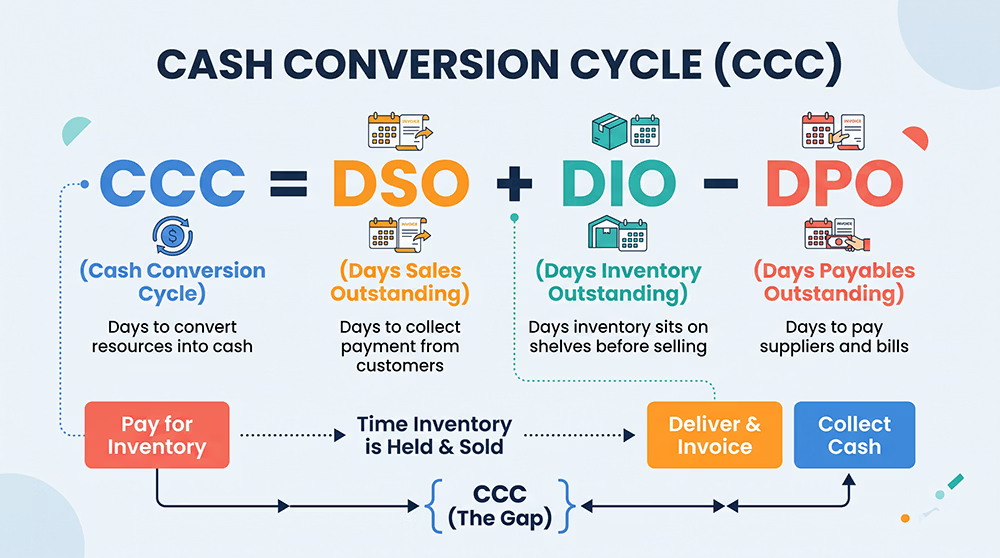
Here’s why it matters. Say you collect in 60 days but pay suppliers in 30. You have to finance a 30-day gap. For a business with $2.4 million in annual revenue, that’s roughly $200,000 of cash you must fund from reserves or borrowing. At today’s rates, that gap carries a real price tag, and it grows every time a big client pays late.
Why Quarterly Forecasting No Longer Works
A quarterly forecast tells you where you ended up. It doesn’t warn you that a $150,000 receivable will slip three weeks while your quarterly tax payment and a large supplier invoice land in the same week.
In today’s environment, cash problems develop in days, not quarters. That’s why more businesses now use a rolling 13-week cash flow forecast: a weekly projection of every dollar coming in and going out over the next quarter (Intuit). It tracks actual cash movements, such as customer receipts, supplier payments, payroll, and taxes, rather than accounting profit (Float).
A 13-week forecast helps you:
- Spot shortfalls weeks before they hit
- Decide when to draw on your credit line, and when to pay it down
- Time large purchases and hires around your cash position
- Negotiate with lenders from a position of strength
- Know exactly which receivables to chase first
Seven Ways to Protect Your Working Capital
- Build a rolling 13-week cash flow forecast. Update it every week. Compare forecast to actual so it gets sharper over time.
- Tighten your billing. Invoice the day work is completed. Every day you wait to bill adds a day to your DSO.
- Set clear payment terms upfront. Put terms, late fees, and deposit requirements in every contract, especially with large corporate clients.
- Work your receivables actively. Review aging reports weekly and follow up at 1, 15, and 30 days past due. Know who approves payment inside each client’s accounts payable department.
- Negotiate with suppliers before you need to. Ask for longer terms while your relationship is strong, not when you’re already stretched.
- Secure credit before a crisis. Set up or expand your line of credit while your financials look healthy. Lenders say yes more easily when you don’t urgently need the money.
- Price for today’s costs. Review margins by customer, product, or job. Raise prices where inflation has quietly eroded your profit.
How TYS LLP Helps You Stay Ahead of Cash Flow
At TYS LLP, we help small and mid-sized businesses turn financial data into decisions. Our Rochester, NY team analyzes your current and past financial performance, identifies red flags early, and builds a strategic plan with clear metrics you can track. We help you build cash flow forecasts, strengthen receivables processes, and deliver timely, accurate financial statements your lenders trust.
For construction companies, we bring more than 60 years of industry experience with job costing, WIP tracking, billing, and bonding requirements, all of which shape cash flow on every project. And through our alliance with Ledgers, Inc., we provide complete bookkeeping services, so your forecast starts from clean, current numbers.
Need ongoing financial leadership? Read our guide on how a fractional CFO helps you beat the CPA shortage. Expanding across state lines? See our article on multi-state tax compliance.
Frequently Asked Questions
What is cash flow forecasting?
Cash flow forecasting projects the cash that will enter and leave your business over a set period. It helps you anticipate shortfalls, plan borrowing, and time major expenses.
What is a 13-week cash flow forecast?
A 13-week cash flow forecast is a rolling weekly projection of cash receipts and payments over the next quarter. You update it each week, adding a new week as the oldest one passes.
What is a good DSO for a small business?
A good DSO depends on your industry and payment terms. As a rule of thumb, your DSO should stay close to your standard terms. If you offer 30-day terms and your DSO is 55 days, customers are paying you late.
How do rising interest rates affect small business cash flow?
Higher rates increase the cost of lines of credit, variable-rate loans, and new financing. If you borrow to cover slow receivables, rising rates make each day of delayed payment more expensive.
How can I improve cash flow without borrowing?
Invoice faster, require deposits on large jobs, enforce payment terms, follow up on past-due accounts weekly, negotiate longer supplier terms, and review pricing to protect margins.
Why does my business show a profit but have no cash?
Profit counts revenue when you earn it, while cash counts money when you collect it. Slow-paying customers, inventory purchases, loan principal payments, and taxes can all drain cash even when you’re profitable.
Take Control of Your Cash Before It Takes Control of You
You can’t control interest rates, inflation, or when a large client finally approves your invoice. You can control how early you see a problem coming.
Schedule a consultation with TYS LLP today. We’ll review your cash position, measure your cash gap, and build a forecast that helps you make confident decisions every week.